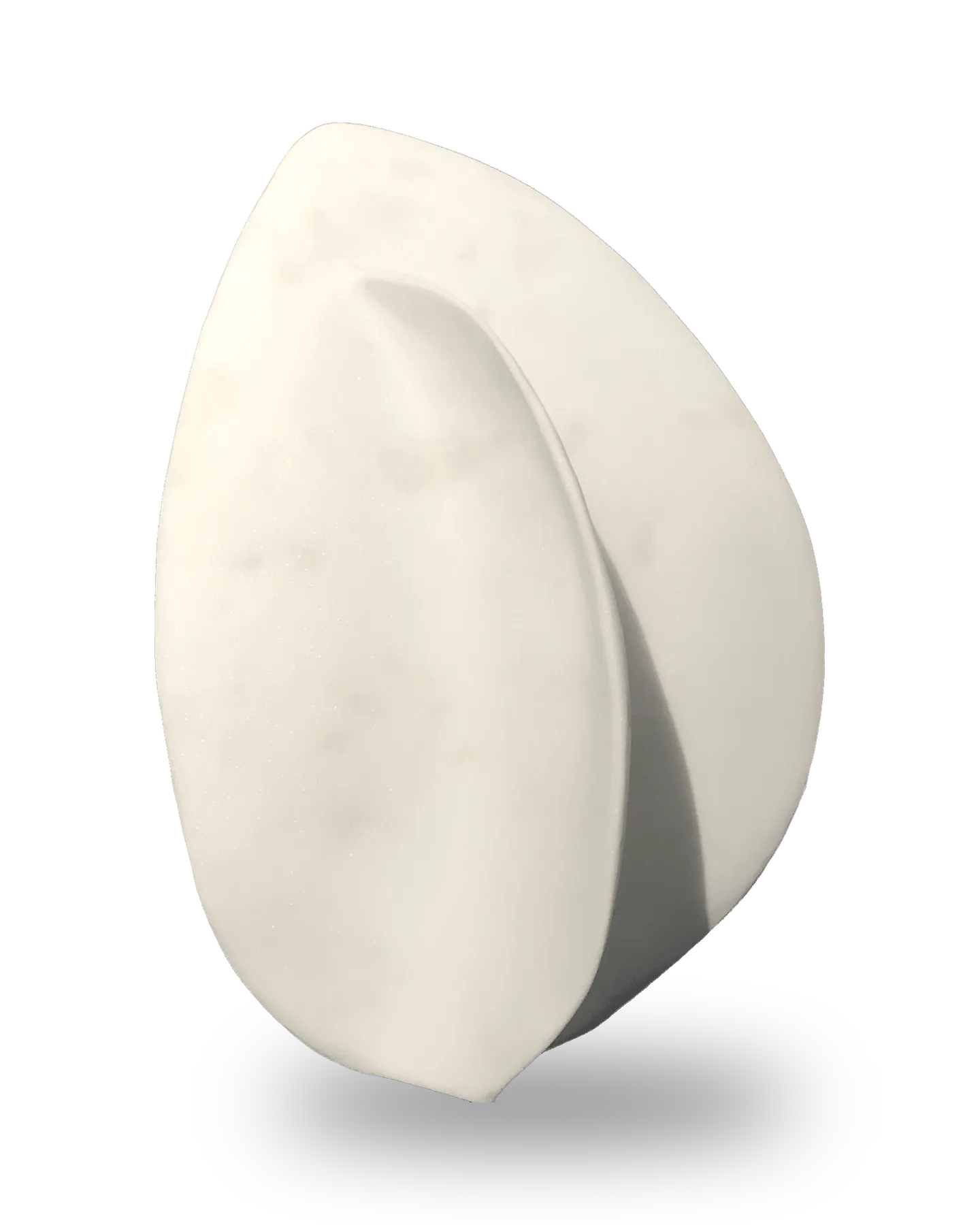
The thinking beneath the stone.
From earth, to light, through transfiguration, into form. Seven chapters on marble, on light, and on the people who stand before a block.
Marble was named for what it does with light.
Its old Greek name, marmaros, means the shining stone. Long before marble was quarried or traded, it was described by the way it met the light. That is where our name comes from: LU for light, NA for Namibia, MARA for the shining stone. It is a name for the light within the stone, and for the stone that carries the light.
The light in marble does not stop at the surface. It enters the crystal, travels a little way inside, and comes back softer. That is why white marble seems lit from within, and why the same work reads differently at dawn, at noon and by lamplight. It is never finished being seen.
Light does not need to be created here. It only needed somewhere to live.
Nothing remarkable forms without pressure.
Long before there was a sculpture, the earth itself was creating. Across ancient Namibia, limestone and mineral-rich sediments gathered beneath ancient waters. Buried deep, they met forces the mind can hardly hold: heat, pressure and time. The crystals rearranged. The structure changed. Marble was born.
At Karibib, in the Erongo region, this happened more than five hundred million years ago. The stone became luminous because it endured the depths.
There is something in this for us. The seasons that stretch us and place us under pressure can become the very forces through which we are formed, and through which our own light begins to show.
Pressure can strengthen. Fire can refine. Time can reveal.
And the marble leaves us with a question. How much pressure can you withstand? How much heat can you endure? And what might be revealed in you when you do?
The sculptor gives the stone its identity.
The stone arrives at the studio in its raw state. Unformed. Unspoken. Endless possibilities. There is only material, imagination and vision.
A master learns to look beyond the surface: to sense movement within stillness, character within form, identity within matter. Through the chisel, the hammer, the eye and the hand, something begins to emerge. A form. A name. A story. An identity.
Marble is not easily persuaded. It asks for time, precision and patience, layer by layer and stroke by stroke, until what was hidden comes forward. Potential stays unseen until someone has the patience, the discipline and the vision to bring it out.
What is waiting to be carved out of you?
Marble is told apart by what it does with light.
We work chiefly in white stone, so our work cannot be divided by colour. It is divided by the behaviour of light in the crystal: how a seam takes the light, holds it, and gives it back. We name seven lights, and an eighth that holds them all. Each light also carries a virtue: what the stone teaches at that stage of its journey.
Each light is also a stage of the journey every work makes, and every person who carves one. Together they are the eight weeks of The Earth To Light Workshop.
Still Light
The Light of PatienceThe unveined white, translucent at its edge. Work that quiets the room it stands in.
What is already here?Given Light
The Light of DevotionThe warm white, honey at the seam. Form reaching toward form.
What have you been given?Radiant Light
The Light of DiscoveryThe high white, the most reflective stone the quarry gives. Weight made weightless.
What are you ready to discover?Standing Light
The Light of SteadfastnessGrey- and steel-veined. Threshold, mass, and stone that holds a space.
Where will you stand?Living Light
The Light of HopeThe green seam. Emergence: the form found by taking away, never by adding.
What is beginning to emerge?Deep Light
The Light of DiscernmentThe dark-veined stone, where light travels furthest before it returns. The detail that took the longest to reach.
What will only patience reveal?Resting Light
The Light of GratitudeThe clouded white. Commemoration, and what a stone is asked to remember.
What do you want to be remembered for?Endless Light
The Light of FaithfulnessThe black stone, which returns nothing and holds everything. The light that remains when the work is done.
What continues after the last stroke?A piece of Namibia's light, carried into a room.
Once a work is finished, the marble does what no other material does. It does not only reflect light. It holds it and gives it back, softly, at every hour: morning on one face, evening on another.
A LUNAMARA sculpture begins in the earth, passes through the hands of its makers, and enters a new space, a new life and a new home. There its journey continues, with the people who live beside it.
The earth held it in darkness. Now it holds the light.
Weeks, sometimes months, for one form.
The seam. Each work begins at the quarry at Karibib, with a block chosen for its seam: how the crystal runs, and what it will do with light.
The block. In the Windhoek studio the sculptor studies the block before the first cut. The form is found by taking away, never by adding.
The form. The work is roughed out, refined and brought to its surface over weeks, sometimes months.
The record. Every finished work is signed, numbered, photographed from all sides and entered in the LUNAMARA archive. It leaves the studio with its own Certificate of Authenticity.
The stone asks the same of everyone who stands before it.
Our sculptors carve marble. For anyone who picks up a chisel, the deeper work is the shaping of the self: seeing what is not yet visible, standing under pressure, taking away what is not the form, and letting the light through.
That is the invitation of The Earth To Light Workshop, and the reason every work in the collection carries the name of the person who made it.